The Democrats’ reported victory in both chambers of Congress changes the terms on which the world must deal with Washington. It gives President Donald Trump’s opponents new institutional means to question his administration, bargain over resources and examine the exercise of American power. It also creates an uncomfortable question for partners: will stronger domestic constraints make American commitments more dependable, or harder to deliver? [1]
The Council on Foreign Relations’ assessment of the 3 November election anticipates stronger congressional scrutiny alongside the substantial foreign-policy powers Trump retains. Its experts also identify the presidential veto as a constraint on legislative reversals. As of 7 November, the result supplies a new political context. The decisions that determine the next phase of American international conduct are still to be made. [1]
An early test comes in Paris on 9 and 10 November. France’s announced G7 agenda includes Ukraine, Middle East stability, energy security and humanitarian assistance. Cooperation on those questions must survive the journey from a diplomatic room to national institutions and the people implementing it. Governments abroad need to know which assurances have the domestic backing to endure. [11]
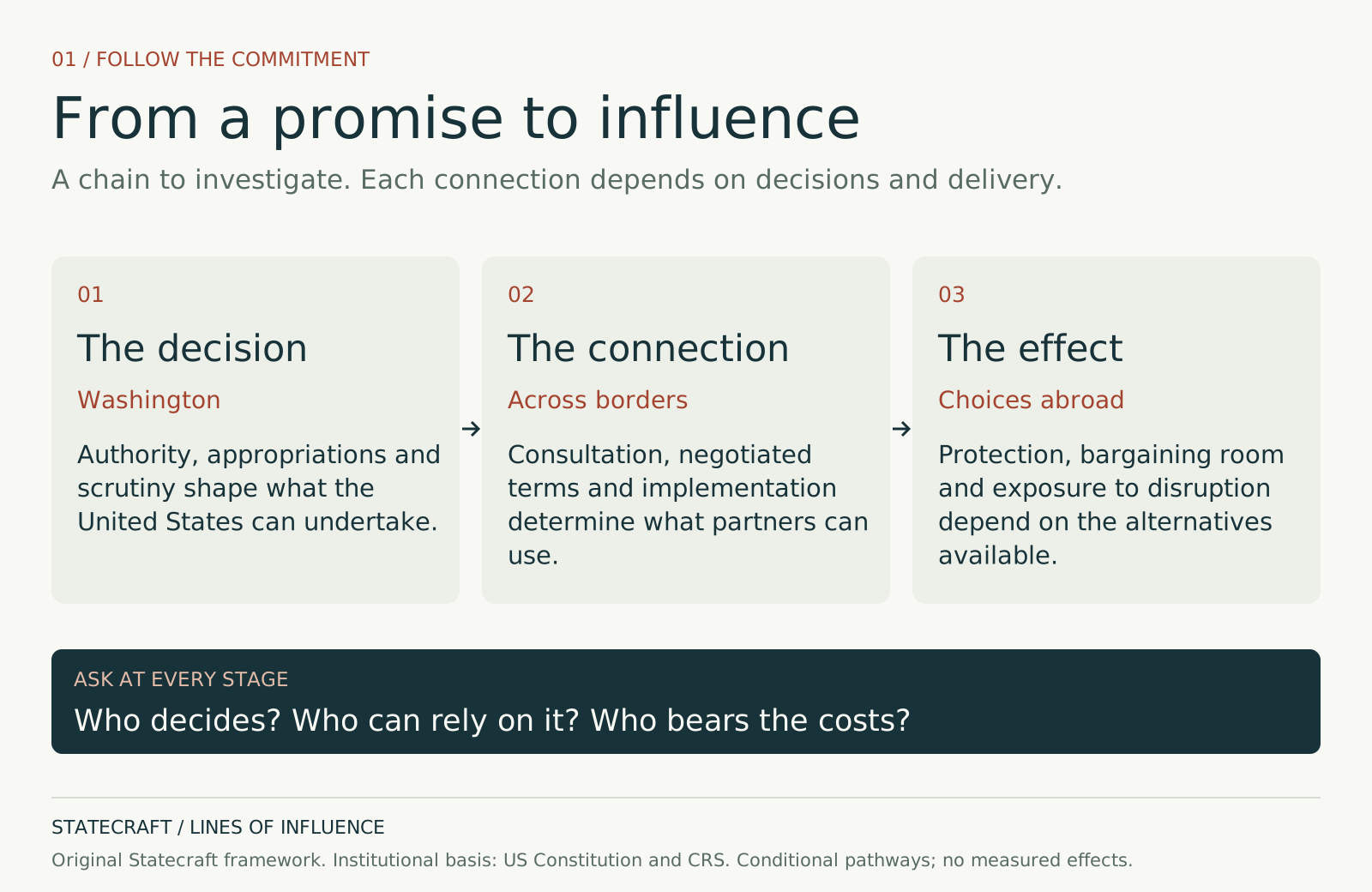
For Lines of Influence, the central argument is that constraints can become a source of international strength when they turn a presidential preference into a commitment institutions can sustain. When they interrupt essential delivery without producing a workable alternative, they export uncertainty. The election makes both outcomes possible. Its international meaning will emerge through the choices that connect American authority with the freedom of others to act.
A result, and two timetables
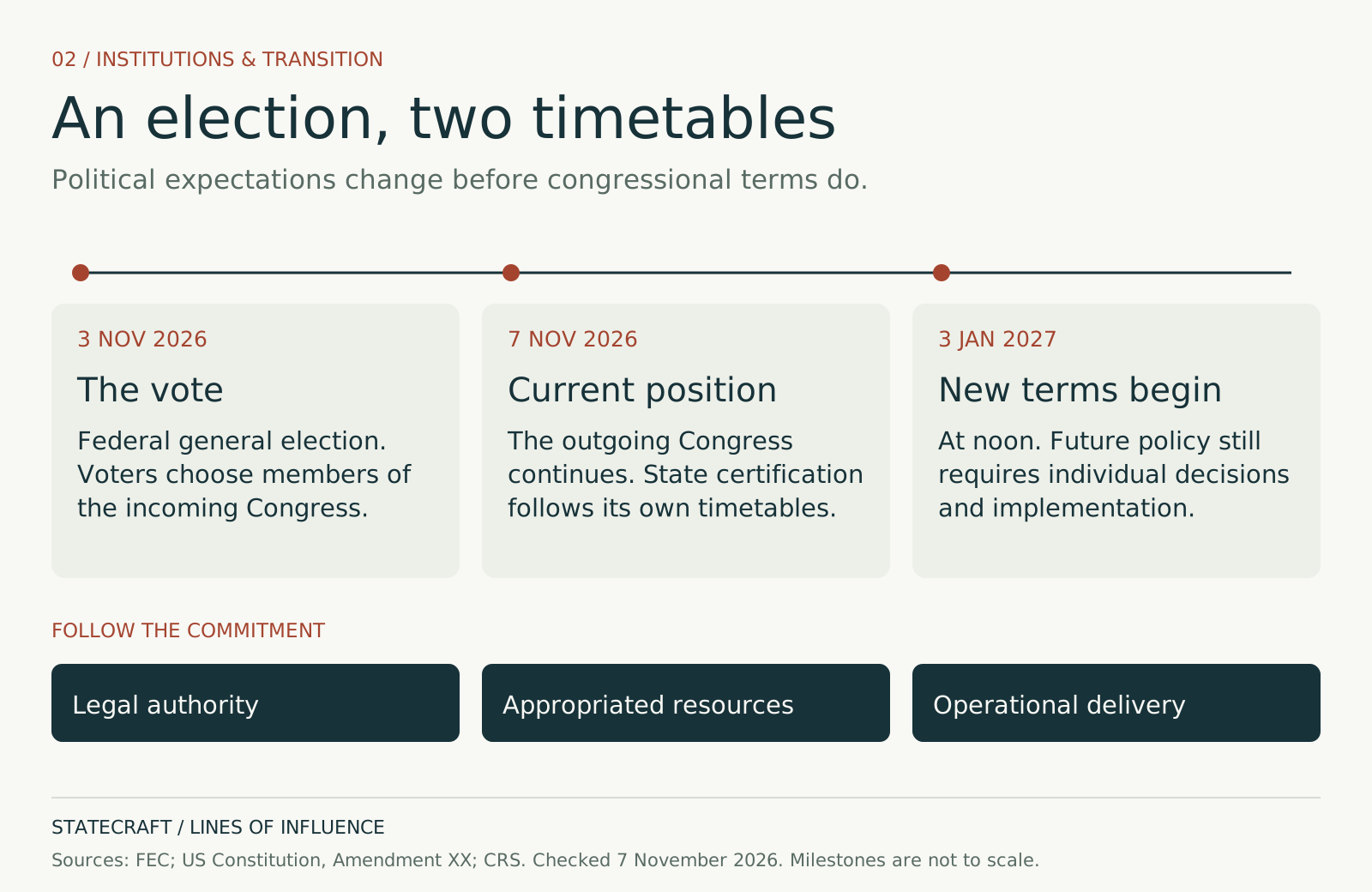
The political timetable has already moved. Partners, officials and businesses can adjust their expectations as they interpret the election. The institutional timetable is different. Under the Twentieth Amendment, the terms of senators and representatives begin at noon on 3 January. The incoming membership’s authority therefore belongs to a distinct constitutional moment. Congress may assemble on a different day if provided by law. [3]
Counting and certification also have their own procedures. The Federal Election Commission explains that elections are administered at state and local level; it compiles results after states certify them. Political reporting about control of a chamber and a final certified compilation answer different questions. This essay uses the reported change in control without turning an unfinished national tally into a claim of precision. [2]
In the interval, the existing Congress continues and the executive continues governing. The White House’s announcement on 6 November that Stephen Miller would succeed Susie Wiles as chief of staff is one immediate example of presidential personnel decisions proceeding after the vote. The announcement establishes an appointment; its consequences for particular foreign-policy decisions require subsequent evidence. [4]
That interval creates a practical problem for partners. An assurance from the administration may concern decisions it can take now, measures requiring the existing legislature, or support it hopes to secure from the incoming Congress. Each has a different basis. A responsible diplomatic assessment would identify the relevant institution and timetable before assigning political meaning to a statement.
There is also a temptation to make a congressional result stand for a complete national instruction. Elections bring together many interests and judgements. Agreement on a candidate can coexist with disagreement over tariffs, assistance, military operations or negotiations. The stronger test comes when representatives must decide on a specific proposal, accept its costs and explain the consequences to those they represent.
Power that others recognise
The English School begins from the possibility that states share a society as well as compete within a system. Barry Buzan’s account draws attention to common rules, institutions and understandings through which political communities conduct their relations. Power remains important, while dialogue, consent and recognised obligations help explain the terms on which it is exercised. [8]
This vocabulary requires care. Congress is a domestic institution; the G7 is a forum organised by governments. The English School also uses ‘institutions’ for deeper practices such as sovereignty, diplomacy and international law. Its contemporary political-economy scholarship examines markets in that wider sense too. Particular organisations operate within, reproduce and sometimes contest those practices. Their relationship to international order extends beyond the success of a single meeting. [8][16]
Great-power status brings a further question about responsibility. Jamie Gaskarth’s study of responsibility in international society examines expectations that powerful states contribute to managing common problems, alongside disputes about what responsible conduct requires. Those expectations remain contested. Leadership, restraint and intervention can acquire different meanings for actors who disagree about the interests and values an arrangement should protect. [9]
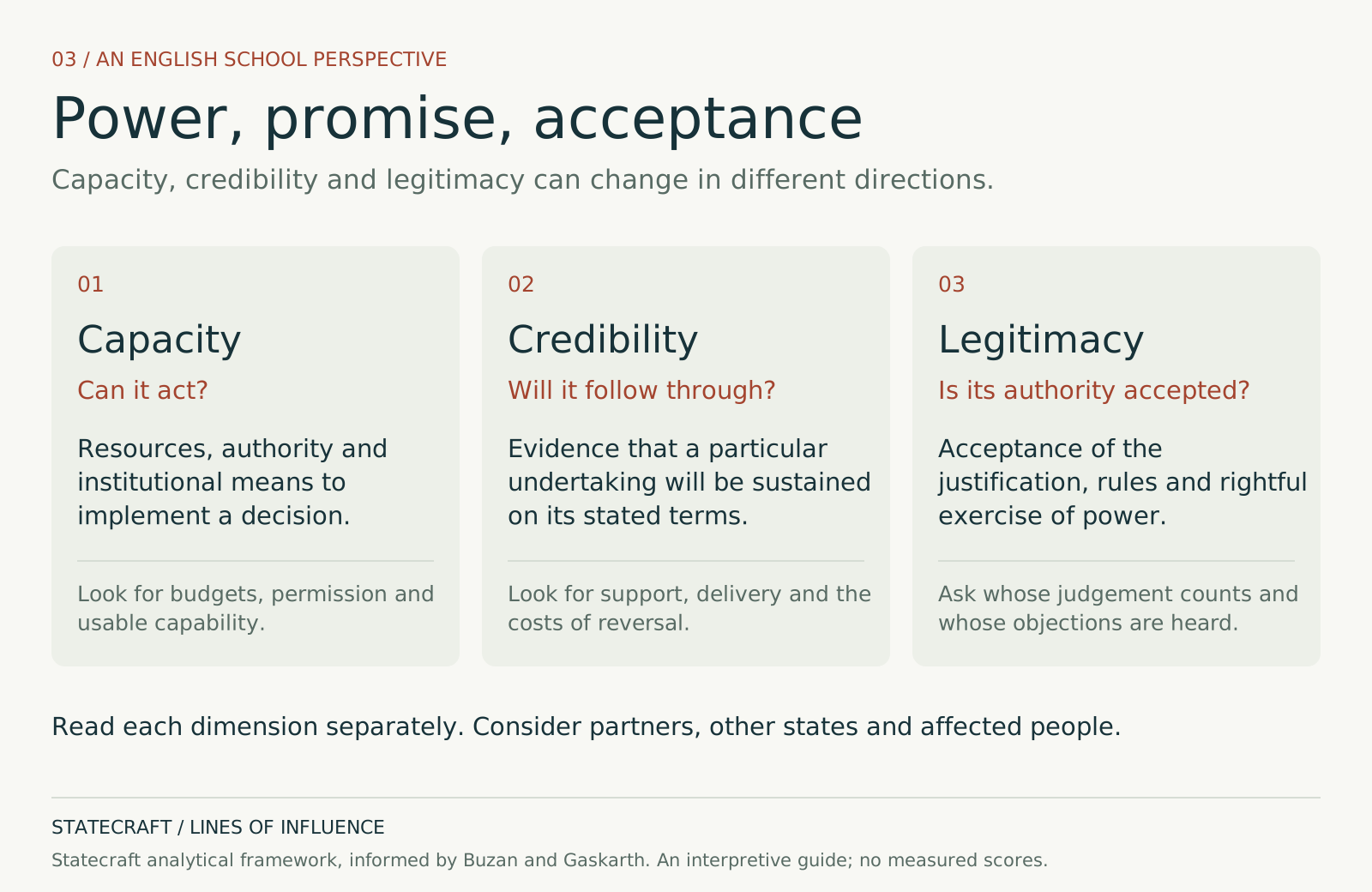
Applied to the American result, three judgements should remain distinct. Capacity concerns the resources and authority to act. Credibility concerns whether a particular undertaking is likely to be sustained on its stated terms. Legitimacy concerns whether an action’s justification and exercise of authority are accepted by relevant others. This is an analytical framework for asking questions, rather than a score assigned to a country.
A government can have the means to act and make a threat others believe while facing serious opposition to its justification. It can also defend a widely supported purpose while struggling to organise the resources required. Partners may value predictability, while affected communities judge the same policy through its consequences for their security or political freedom. Agreement among allies cannot settle every such claim.
Democratic scrutiny can contribute to legitimacy when it exposes choices to public justification and subjects officials to accountability. Its international effects depend on what scrutiny produces. A well-examined decision may be more sustainable; a publicly contested commitment may become less certain. The election creates possibilities for both. The argument must follow conduct, including whose objections receive a hearing and whether institutions can correct failures.
Europe and the work of reassurance
For European governments, the immediate question is how political change affects usable cooperation. France’s programme for the forthcoming G7 meeting identifies Ukraine’s capacity, finance and energy needs among the subjects for discussion. The schedule provides a concrete setting in which partners can clarify priorities and test areas of agreement. A published agenda establishes the intended discussion, while the resulting commitments remain open. [11]
The relevant instruments carry different expectations. NATO’s Article 5 requires assistance following a covered armed attack, with each ally taking the action it deems necessary, including the possible use of armed force. Article 11 places implementation within national constitutional processes. Collective defence thus combines an international obligation with decisions about how it is carried out; assurances must be read alongside the undertaking’s actual terms. [10]
Specific assistance to Ukraine must likewise be examined through its own legal and financial arrangements. A party’s general sympathy for a recipient cannot establish the timing, scale or conditions of a particular decision. Governments seeking reassurance would gain more from identifying authorised resources, sustainment requirements and dependable channels of consultation than from treating a change in Washington’s political atmosphere as a complete security assessment.
European agency belongs within that account. Article 3 of the North Atlantic Treaty envisages individual and collective capacity developed through self-help and mutual aid. Partners have responsibilities and choices concerning their own contribution. [10] Their ability to bargain with Washington depends partly on what they can provide, the alternatives they can develop and the costs they are willing to share.
This creates a demanding test for claims of strategic autonomy. A government may seek greater freedom by strengthening common procurement, diversifying a supply relationship or building domestic capacity. Whether that expands its choices depends on the capability produced and the time required. Replacing an established connection can itself create new dependencies. The objective deserves assessment through the options available in a real disruption.
Reassurance is therefore continuing political work. Consultation can reduce uncertainty, scrutiny can expose gaps, and shared planning can make assistance more usable. Each partner also brings its own domestic constraints. A durable arrangement has to accommodate those constraints while giving participants enough confidence to act. The American election changes an important part of that negotiation; Europeans still help determine the terms.
Economic power and the price of uncertainty
Trade presents a related problem. Congress’s constitutional authority over foreign commerce is part of the institutional setting, while the scope of any particular presidential measure depends on the authority invoked and its legal limits. [5] A congressional majority does not, by itself, replace the rules under which businesses or governments operate. Where reversal requires legislation, the obstacles to passing that legislation remain consequential.
Yet uncertainty can influence behaviour before a rule changes. A firm choosing where to invest must weigh how long market access will last. A government negotiating a concession must assess whether its counterpart can sustain the exchange. If another American institution might later revise the bargain, a partner could demand stronger safeguards, offer less in return or postpone a decision. These are mechanisms to investigate, rather than evidence that every partner has already responded in the same way.
A useful counterargument is that flexibility can strengthen bargaining. Keeping several options open may help Washington extract concessions, and a threat can be credible precisely because the executive can act quickly. But flexibility has a cost if counterparts cannot distinguish a negotiable demand from an undertaking they can safely build upon. Effective diplomacy needs some capacity to close a bargain as well as reopen one.
This is a wider question of international order. Markets depend on expectations about rules, access and enforcement. Those expectations distribute opportunities among states and firms with unequal alternatives. For a smaller economy, the freedom to diversify may be limited by geography, infrastructure or finance. The effect of American political disagreement therefore turns partly on the choices available elsewhere. Influence is relational: uncertainty in Washington can carry greater costs for actors least able to move.
The Gulf and the costs of disorder
The Middle East presents a contrasting test because the costs of conflict cross several kinds of relationship at once. The G7 agenda links regional stability with diversifying and securing energy supplies. Its framing connects diplomacy and security with the conditions under which economies operate. It also raises questions about which governments and communities can influence decisions whose consequences reach them. [11]
Britain’s experience supplies a specific connection. On 5 November the Bank of England raised Bank Rate to 4%, attributing important inflationary pressures to the protracted Middle East conflict and higher energy prices. Its minutes distinguish the original global shock from domestic pressures monetary policy can influence. This is the Bank’s assessment of the economic transmission, rather than a judgement that a single government controls the outcome. [12]
The connection makes the distribution of costs politically significant. A military or diplomatic decision can change conditions faced by people outside the states making it. Governments respond through different budgets, institutions and social arrangements. An energy producer, an importing economy, a household and a firm may experience the same disruption differently. Identifying those differences is part of understanding whose choices international disorder restricts.
Congressional constraints must be assessed with comparable precision. CRS’s account of the War Powers Resolution describes a framework intended to ensure collective judgement over the introduction of American forces into hostilities, while recording disputes over its interpretation and application. The relationship between military operations, legislation and funding is politically and constitutionally contested. A new majority adds actors and incentives to that process; it supplies no automatic settlement. [15]
An assessment of responsibility also requires an international frame. The UN Charter establishes sovereign equality, peaceful settlement and rules governing the threat or use of force, alongside its provisions for collective security and self-defence. Domestic political support does not exhaust the relevant questions. An action’s legal basis, its justification to others and its consequences for affected people each require examination. [13]
For Gulf governments, the practical inquiry would concern how commitments connect protection, restraint and diplomatic room to act. More force could reassure one participant while increasing another’s exposure; a negotiation could reduce immediate dangers while leaving important interests unresolved. These are possibilities to test against evidence. Regional actors retain objectives and bargaining choices of their own, and a credible account must investigate them directly.
The English School’s concern with order and justice sharpens that assessment. Restoring predictable shipping and reassuring governments would answer important questions about stability. It would leave further questions about civilian protection, political exclusion and whose security counts in the settlement. Different answers can coexist within one apparent diplomatic success. Responsibility requires attention to people living with the arrangement as well as the states able to endorse it.
Promises with lives attached
The consequences extend beyond alliances and military operations. Goal 17 of the Sustainable Development Goals places finance, technology, capacity-building and partnership within the means of pursuing shared development ambitions. Its targets connect international cooperation with national capabilities. [14] That connection makes the domestic foundations of major powers’ commitments relevant to the longer story of progress towards 2030.
An assistance programme depends on more than agreement about its purpose. Funds require institutions able to administer them, partners able to plan around them and procedures that make responsibilities clear. A change in congressional priorities could affect one or more of those conditions. Assessing the consequences would require tracing particular decisions through the programme, rather than presuming that a political preference immediately becomes a delivered service.
This brings order and justice into the same field of inquiry. Reliable arrangements may help governments plan, while their conditions distribute influence unevenly. A recipient may obtain valuable resources and face costly restrictions on its choices. The people meant to benefit can have less influence over the bargain than the institutions negotiating it. Stability is one consideration; the purposes and distribution of that stability also matter.
Smaller states can respond through diplomacy, regional coordination and alternative relationships. These strategies can widen their options, although each carries costs and requires usable capacity. Lines of Influence should follow that agency alongside vulnerability. Dependence provides an explanation only when we establish which decision is exposed, how an outside actor could change its terms and what alternatives the affected participant can actually use.
What the promises become
The next stage will be visible through decisions: appropriations and their conditions, scrutiny and its findings, appointments and the authority attached to them, and agreements followed into implementation. The Paris meeting offers an early opportunity to hear how partners frame those choices. January brings a different congressional membership into office. Neither date can resolve the whole question of American reliability in advance.
The midterm result has changed the domestic foundations on which international commitments must rest. Its consequences for international society will depend on how those foundations support responsible conduct, workable cooperation and room for others to act. Scrutiny that makes a promise more realistic may strengthen it. Bargaining that leaves essential support uncertain may weaken the choices of a partner. Both possibilities belong within the investigation.
America’s power remains a relationship with those asked to rely on it and those affected by its exercise. The test after the vote is whether that power can sustain commitments partners can use, institutions can support and affected societies have reason to regard as legitimate.
Sources & notes
- Council on Foreign Relations, Democrats Win Control of Congress. Here’s How That Could Affect U.S. Foreign Policy, 4 November 2026 ↗Back to the essay ↑
- Federal Election Commission, Election results and voting information; accessed 7 November 2026 ↗Back to the essay ↑
- US National Archives, Twentieth Amendment, sections 1–2: congressional terms and assembly; accessed 7 November 2026 ↗Back to the essay ↑
- White House, President Trump Names Stephen Miller as 33rd White House Chief of Staff, 6 November 2026; cited for the appointment announcement ↗Back to the essay ↑
- US National Archives, Constitution of the United States, Articles I and II; accessed 7 November 2026 ↗Back to the essay ↑
- Congressional Research Service, Congress and National Security: Selected Tools and Issues for the 119th Congress, IF12858, 20 December 2024; institutional background ↗Back to the essay ↑
- US Senate, About Treaties; accessed 7 November 2026 ↗Back to the essay ↑
- Barry Buzan, From International to World Society? (2004), Cambridge University Press introductory excerpt; analytical framework ↗Back to the essay ↑
- Jamie Gaskarth, Rising Powers, Responsibility, and International Society, Ethics & International Affairs 31(3), 2017, pp. 287–311; analytical framework ↗Back to the essay ↑
- North Atlantic Treaty, 4 April 1949, especially Articles 3, 5 and 11; official NATO text, accessed 7 November 2026 ↗Back to the essay ↑
- French Ministry for Europe and Foreign Affairs, Priorities of the G7 Foreign Ministers’ Meeting in Paris, 6 November 2026; meeting scheduled for 9–10 November ↗Back to the essay ↑
- Bank of England, November 2026 Monetary Policy Summary and Minutes, published 5 November 2026 ↗Back to the essay ↑
- Charter of the United Nations, especially Articles 2, 33 and 51; official treaty text ↗Back to the essay ↑
- United Nations, Sustainable Development Goal 17: targets and means of implementation; accessed 7 November 2026 ↗Back to the essay ↑
- Congressional Research Service, Understanding the War Powers Resolution, IF13134; accessed 7 November 2026, institutional background ↗Back to the essay ↑
- LSE Research, The fluctuating fortunes of the market, 23 September 2025, discussing Robert Falkner and Barry Buzan’s English School approach to political economy ↗Back to the essay ↑
This is an analytical essay, grounded in the dated developments and official positions above. Interpretations and illustrative scenarios are distinguished from reported events. Drafted with AI assistance. Maps and evidence graphics: Statecraft. Documentary photographs are dated and credited individually. Read our editorial approach.